
REPORT IN BRIEF
Each year, the Capital Area produces a Hunger Report that explores the state of food insecurity across the Greater Washington, DC region.
The only report of its kind, the findings of this annual publication are the result of a general population survey conducted in partnership with the highly trusted independent social research organization NORC at the University of Chicago. Nearly 4,000 individuals were surveyed using designed by the U.S. Department of Agriculture to measure food insecurity.
A summary of the 2026 report is below.
Food insecurity trends in Greater Washington
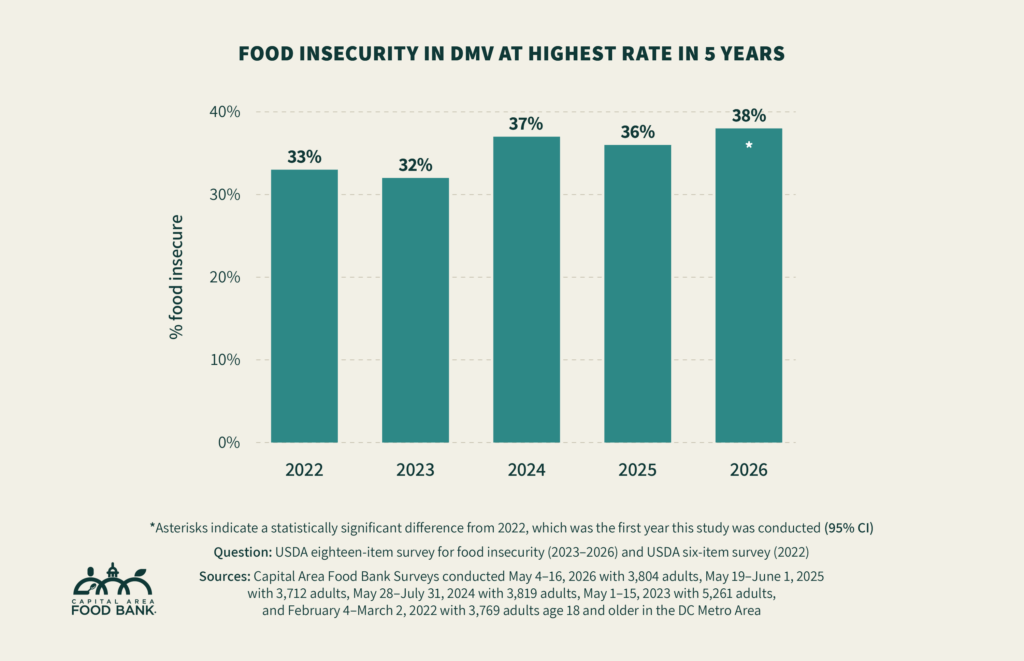
Food insecurity in the DMV hits a five-year high
The Greater Washington region is experiencing higher levels of hunger than seen near the height of the COVID-19 pandemic.
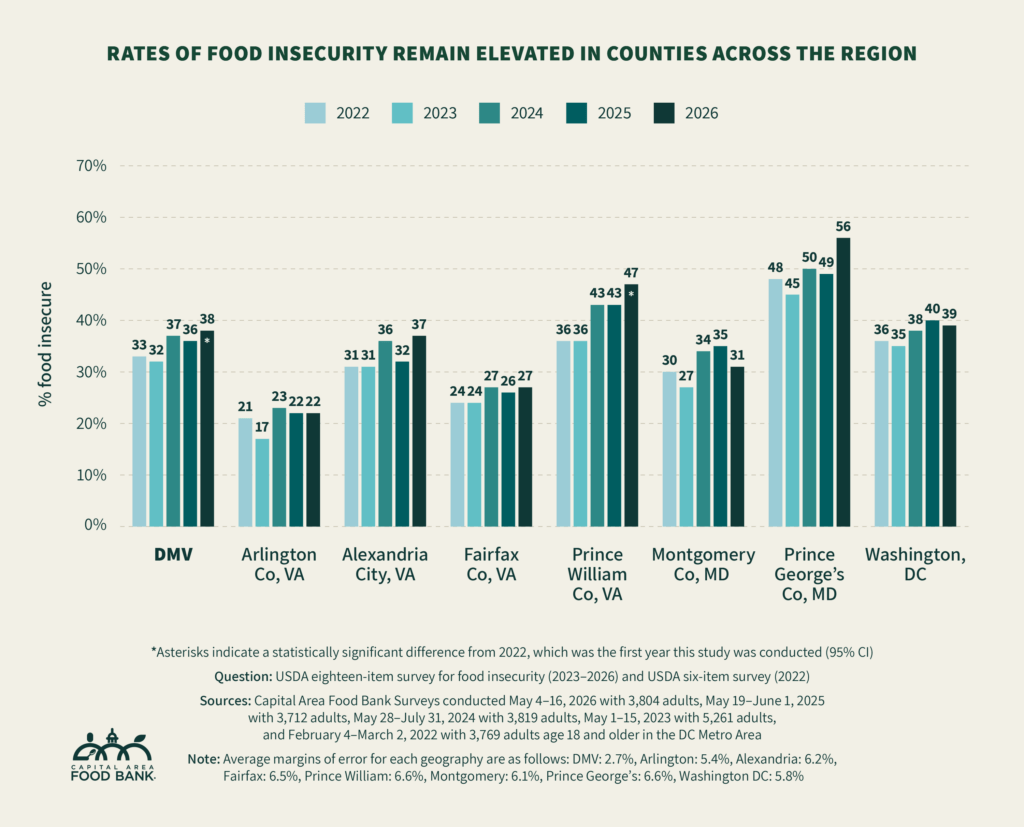
New data from the Capital Area Food Bank’s latest Hunger Report found that food insecurity has reached a five-year high, with 38% of households in the region not always knowing where their next meal would come from.
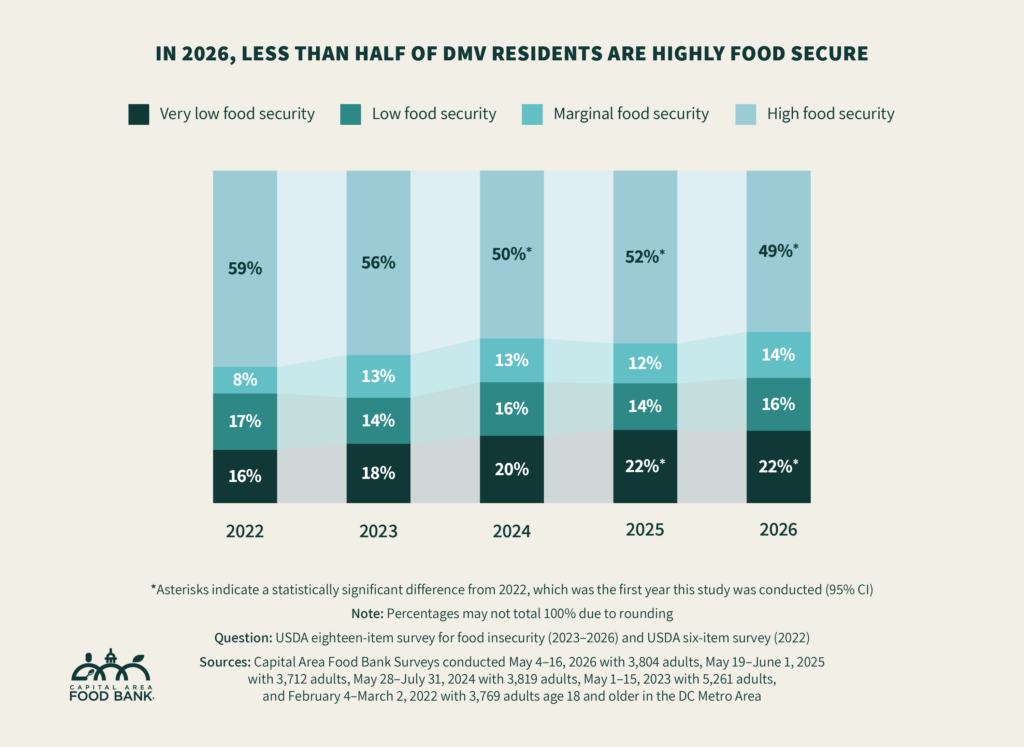
Dramatic job losses, higher costs of living, and a record-setting federal government shutdown all contributed to deteriorating food security across the DMV. For the first time in the report’s history, under half of households – 49% – were categorized as “highly food secure,” a drop of 10 percentage points since 2022. That means a declining number of households feel highly confident in their ability to put enough food on the table.
In every county across the Greater Washington region last year, at least 1 in 5 households were food insecure, ranging from 22% in Arlington, Va., to 56% in Prince George’s County, Md. The only county in the region to show a decline was Montgomery County, Md., where food insecurity dropped from 35% to 31%, though that change was within the survey’s margin of error.
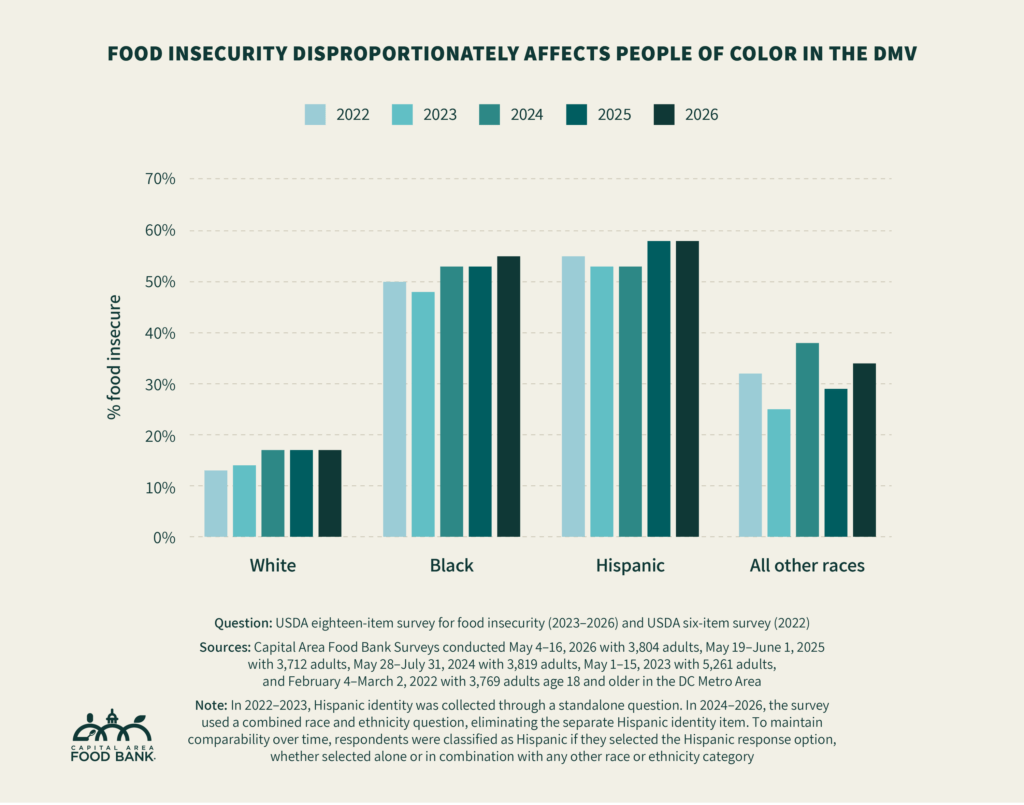
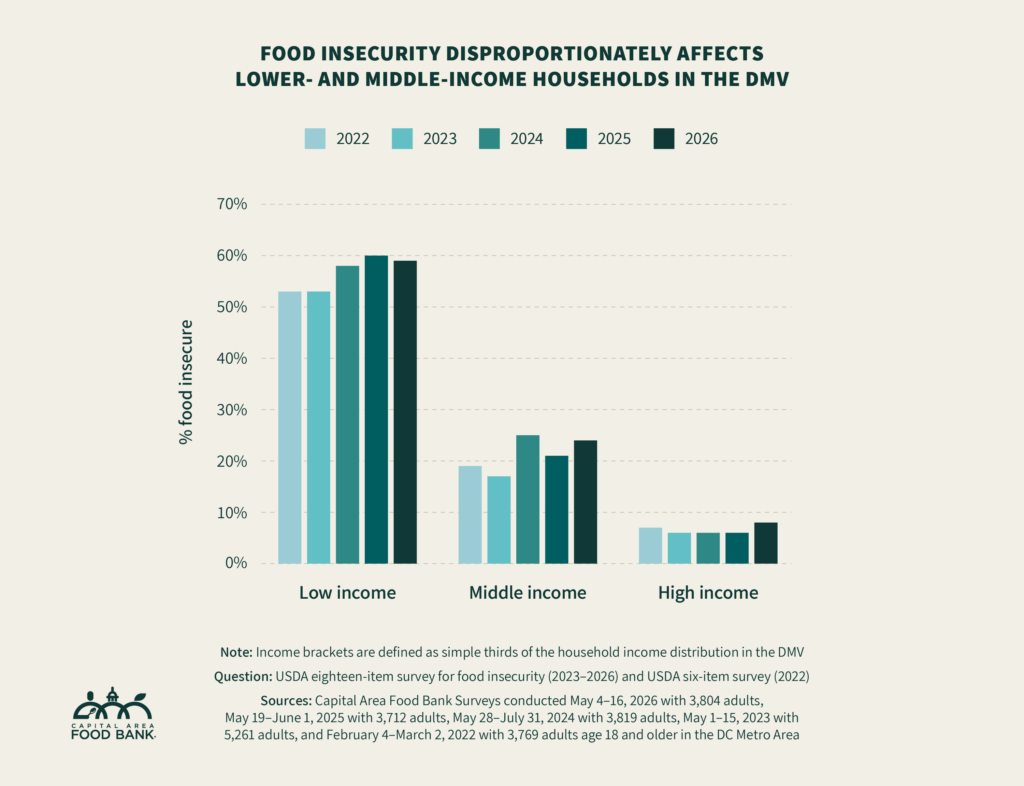
Food insecurity continues to disproportionately affect certain demographics:
- Non-white households experience rates of food insecurity at rates two to three times higher than white households.
- Three out of five low-income households and one out of four middle-income households were food insecure.
Households with children also face greater challenges: 34% of children in the DMV – 1 in 3 – lived in food insecure households in the last year.
Major drivers of food insecurity
When households are faced with financial instability, food budgets are often one of the first things to shrink.
A challenging job market, high cost of living, and slow wage growth are causing more DMV households to feel an increased strain on their finances. Among respondents, 44% reported that their finances have gotten worse in the last year, up from 35% in 2022. More than one-third cited negative changes in the economy as a key reason for that financial decline.
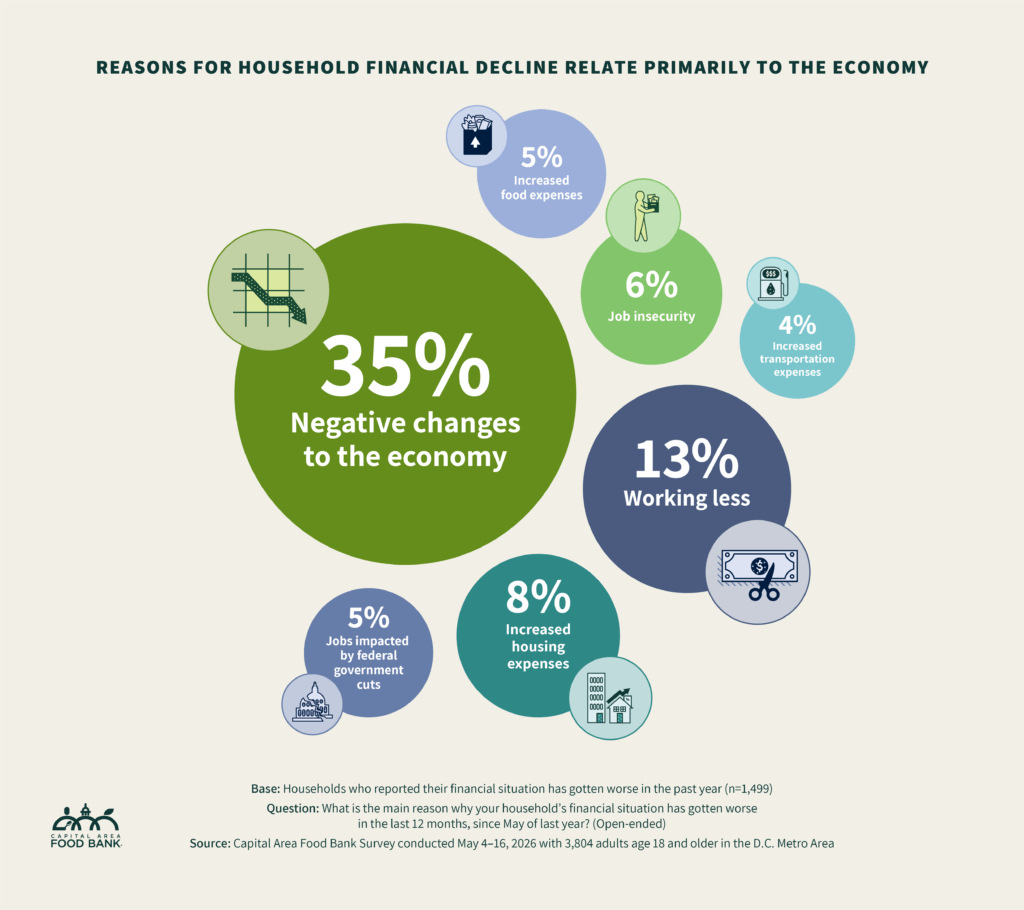
For DMV residents, finances grew tighter as the region faced the most dramatic job losses of any metro area in the country: 100,000 jobs were eliminated between January 2025 and January 2026. Many of these job losses were a result of the reductions in the federal workforce.
The consequences of the federal job losses continue to have ripple effects for residents:
- 44% of those who have found reemployment receive a lower salary
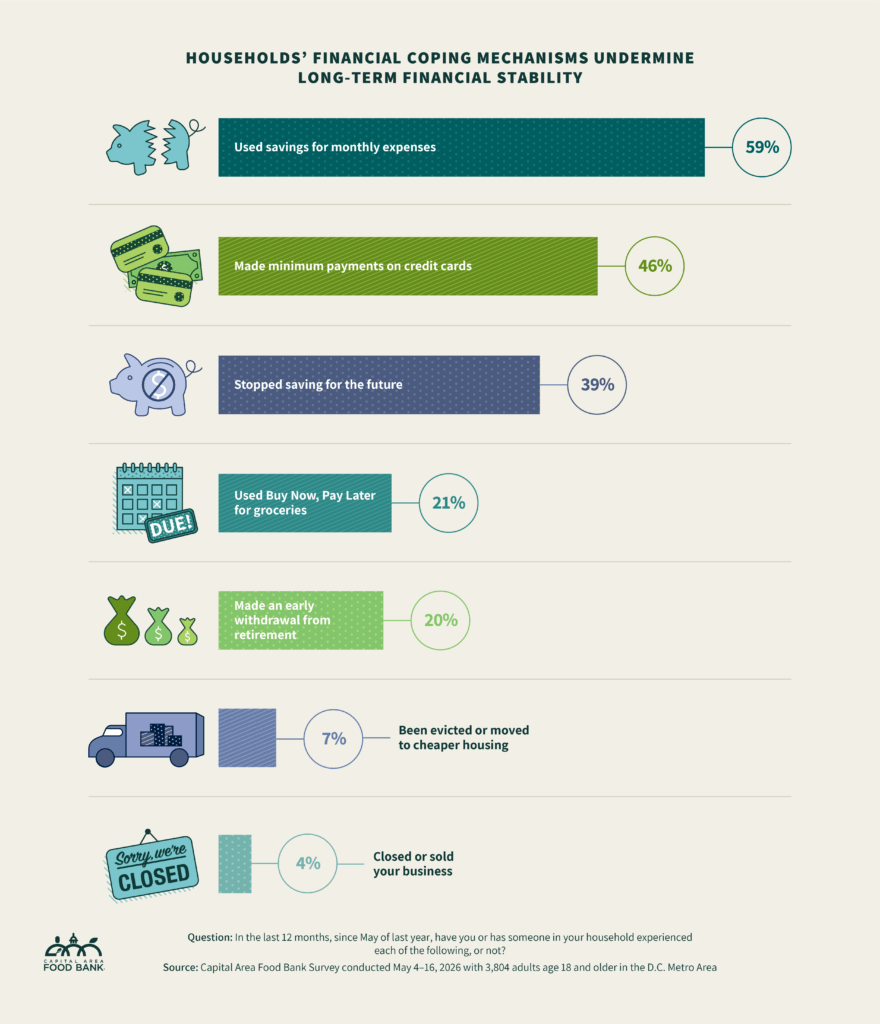
Even for those who are employed, putting food on the table remains a challenge amongst a skyrocketing cost of living. With high food costs, spikes in gasoline prices, and wage growth that has lagged inflation, families are cutting back and making difficult .
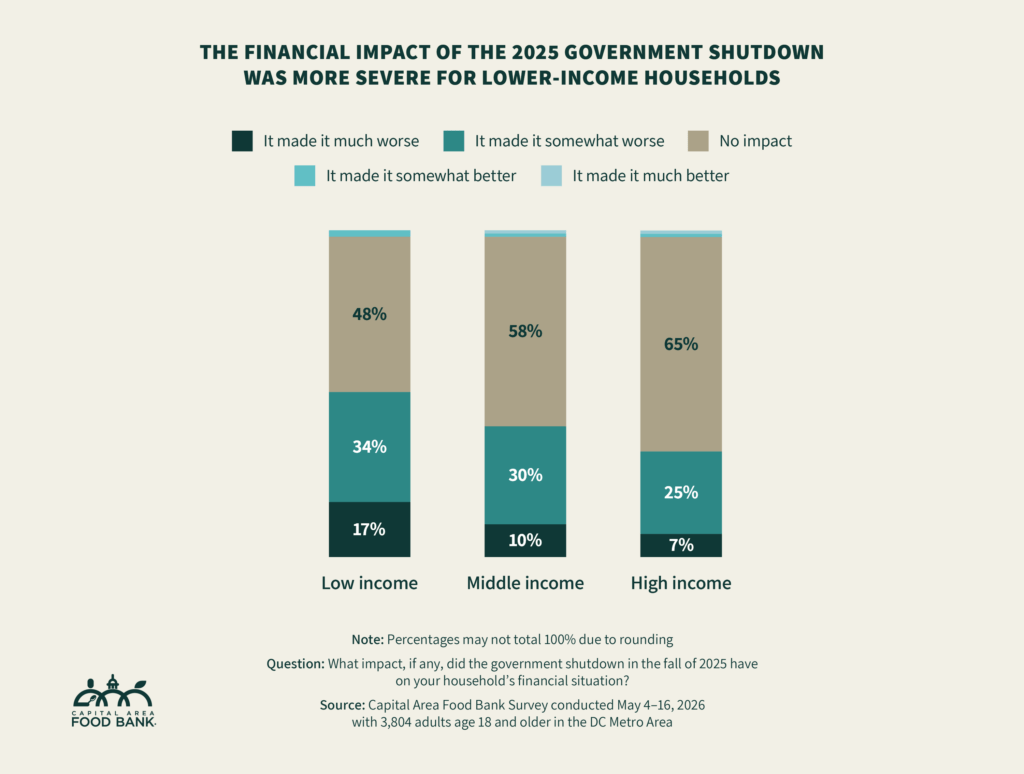
On top of these broader economic pressures, the region endured a 43-day federal government shutdown in October and November 2025. Disrupted paychecks and uncertainty around lost wages placed even greater strain on household finances, leaving more people vulnerable to food insecurity. Nearly half the population reported it worsened their financial situation, with lower-income households more likely to report negative effects from the .
Factors poised to compound existing need
As food insecurity hits a five-year high, changes to the social safety net further threaten the stability of the region.
House Resolution 1 (H.R.1) contains legislation that makes unprecedented changes to the Supplemental Nutrition Assistance Program (SNAP):
- $187 billion in cuts to the program over 10 years
- Removal of SNAP access for refugees and asylum seekers
- Time limitations for accessing the program placed on new groups – including adults up to age 64 (formerly 54), parents of children 14+ (formerly 18+), homeless individuals, veterans, and young adults aging out of foster care – who do not meet certain work or volunteering requirements or qualify for other exemptions
- Caps on benefit increases
- Elimination of SNAP-ed
- Increased administrative costs for states
- States to pay for a portion of benefits
Even a partial loss of benefits stands to significantly impact those who turn to SNAP to help feed their households:
- 56% of SNAP recipients reported that their financial situation got worse over the last 12 months
- 71% are using savings to pay monthly bills
- 61% are making minimum payments on credit cards
- 53% have stopped saving for retirement or other future expenses
A diminished social safety net and mounting economic pressure are driving more people to the charitable food network: 28% of DMV residents access charitable food.
At the same time, fewer foreign-born individuals are seeking assistance. Fear of immigration enforcement and other safety concerns are keeping individuals from accessing aid for themselves and their families. Among the Capital Area Food Bank’s network of partners, 29% reported an increase in the number of individuals who accessed food via a proxy rather than attending a food distribution themselves.
Recommendations
- Mitigate the impacts of changes to SNAP
Federal changes to SNAP mean that states will be responsible for covering a greater share of the cost of food security programs and ensuring that those who seek assistance meet certain requirements. By continuing to invest in food security programs, reducing administrative barriers, and strengthening partnerships to help residents navigate new requirements to qualify for benefits, state and local governments can help their residents continue to get the food they need. Governments should also focus on ensuring children do not face disruptions in food access as household circumstances change by strengthening school meal programs and child nutrition initiatives. - Coordinate services across the charitable sector
Food insecurity doesn’t exist in isolation. As public benefits are reduced and more people turn to the charitable sector for help, organizations must work together to strengthen connections across services. Along with expanding their own capacity, nonprofits, healthcare providers, community institutions, and others should establish a connected system that makes support easier to find and navigate for the households that need it most. - Invest in basic need support to strengthen economic mobility
As noted in previous Hunger Reports, addressing food insecurity requires more than ensuring people have enough food today. People experiencing food insecurity are actively seeking opportunities for greater economic mobility, yet the need to afford basic necessities can take priority over long-term advancement. Investing in wraparound services that support those immediate needs allows individuals to focus on their education and career growth. In turn, this creates a new pool of talent ready to enter the workforce and strengthen the regional economy. - Scale Food Is Medicine work
Individuals experiencing food insecurity who cannot access healthy food and balanced meals are more likely to develop diet-related diseases, leading to higher medical costs and poorer health outcomes. The Food Is Medicine (FIM) movement is grounded in the principle of prescribing and providing nutritious food as a healthcare intervention. Developing sustainable funding pathways and investing in the infrastructure needed to deliver these interventions at scale will help make nutrition a regular component of healthcare and improve population health.