
New 4,000-person general population survey also reveals the lingering impacts on federal workers who were laid off and struggled to find new employment
_____________________________________________________________________________________
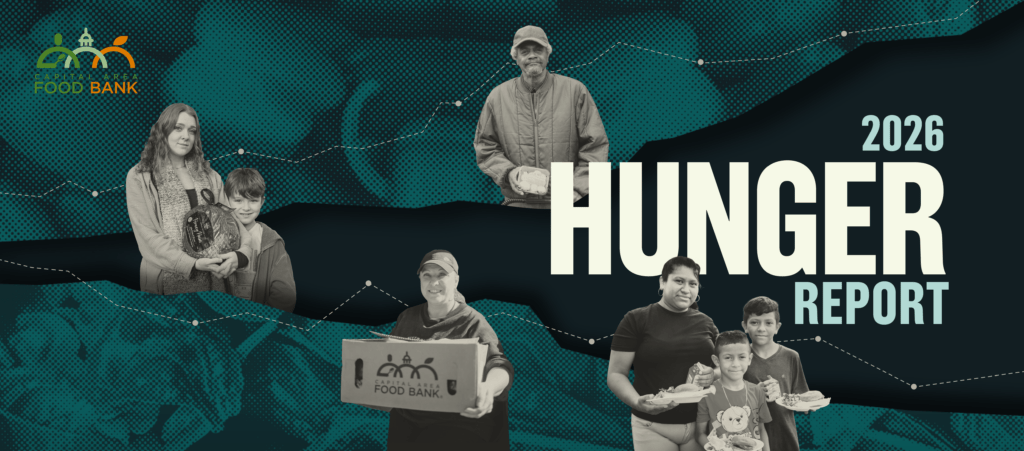
Washington, DC, September 15, 2026 – The Greater Washington region is experiencing higher levels of hunger than near the height of the COVID-19 pandemic, according to a report on food insecurity issued today by the Capital Area Food Bank (CAFB).
The new report found 38% of respondents struggled to access enough food or the types of food needed at some point between May 2025 and May 2026. That’s a significant rise during the last five years, up from 33% in 2022.
The overall level of food security in our region is deteriorating. For the first time in the report’s history, under half of households – 49% – were categorized as “highly food secure.” This means that less than half of DMV households have high confidence in their ability to secure enough food and reflects a drop of 10 percentage points since 2022.
Nearly half of DMV households said that their finances got worse, a finding that follows a year of economic instability in the region. Inflation and high prices have strained household budgets as the D.C. metro region led the nation in the number of job losses in 2025. Among federal employees and contractors who were laid off, fired, or quit, 35% are still unemployed, and among those who found re-employment, 44% said they are now earning a lower salary.
“After unprecedented job losses last year and the deepening pressure of high prices for essentials like gas and food, our community has seen food insecurity reach its highest level in five years,” said Radha Muthiah, President and CEO of the Capital Area Food Bank. “This year’s Hunger Report underscores the deteriorating state of food security in our region and the need for decisive action across every sector. With recent policy changes likely to place additional pressure on families in the years ahead, the challenge before us is not only to meet the growing need, but to work together to help more families achieve lasting stability.”
Hunger Report 2026 is the seventh such study issued by the CAFB, and for the fifth consecutive year, the data informing the report was gathered through a general population survey conducted in partnership with the highly trusted independent social research organization NORC at the University of Chicago. The full report and previous reports can be found on the Capital Area Food Bank’s website.
Data Highlights:
Food Insecurity is still widespread.
- At the county level, food insecurity remained extremely elevated. Rates ranged from 22% of residents in Arlington, VA to 56% of the residents of Prince George’s County, MD.
- Montgomery County, Md., was the only county in the region to show a decline, dropping from 35% to 31%, though that change was within the survey’s margin of error.
- Households with children also face greater challenges: 34% of children in the DMV – 1 in 3 – lived in food insecure households in the last year.
A challenging job market and high costs of living are causing DMV households to feel increased strains on their finances.
- More than one-third cited negative changes in the economy as a key driver of household financial decline.
- Many households have adopted strategies that provide short-term relief but can undermine long-term financial stability: Nearly six in ten households reported using savings to cover monthly expenses, while almost half said they were making only minimum payments on credit cards or other loans.
Changes enacted in House Resolution 1 (H.R. 1) will continue to profoundly impact thousands of people’s federal benefits in the DMV area.
- Even a partial loss of benefits stands to significantly impact those who turn to SNAP to help feed their households, with 56% of SNAP recipients reporting that their financial situation worsened over the past year.
- As losses to the social safety net and mounting economic pressure drive more people to the charitable food network, those organizations will face growing strain to meet that need.
About the Capital Area Food Bank
The Capital Area Food Bank works to address hunger today and create brighter futures tomorrow for more than a million people across the region experiencing food insecurity. As the anchor in the area’s hunger relief infrastructure, the food bank provided 64 million meals to people in need last year by supplying food to hundreds of nonprofit organizations, including Martha’s Table, SOME – So Others Might Eat, DC Central Kitchen, Food for Others, Manna, and others. It also works in partnership with organizations across the region to address hunger’s root causes by pairing food with critical services such as education, health care, and job training. To learn more, visit https://www.capitalareafoodbank.org.
Media contacts:
Laura Olson
(202) 644-9870 (desk)
(717) 903-9023 (cell)
lolson@capitalareafoodbank.org
Hilary Salmon
(202) 644-9864 (desk)
(518) 810-8582 (cell)
hsalmon@capitalareafoodbank.org
###